




In the evocative multi-artworks project, The War Within: Breaking Out of Perdition, the journey of a marginalized Black man unfolds through a tapestry of digital artworks and paintings. Each piece delves deep into the intricate and often tumultuous internal conflicts faced by individuals navigating systemic oppression and personal identity. Through bold concepts, symbolism, contrasting colors, and transformative storytelling, this series will transcend traditional art forms, inviting viewers to confront not only the protagonist's journey but their own.
Each piece will represent a different aspect of internal conflict, such as battling one's own fears, doubts, conflicting emotions and inflicted conditions.
The use of contrasting colors, textures, and materials symbolizes the complexity of these internal struggles. The artwork will evolve from darker and chaotic elements towards more harmonious and resolved compositions, reflecting the journey of overcoming inner conflicts.
This project encourages viewers to reflect on their own inner struggles and find inspiration in the idea of finding peace amidst personal wars.
Key Artworks and Their artanatomy
1° Revelations:
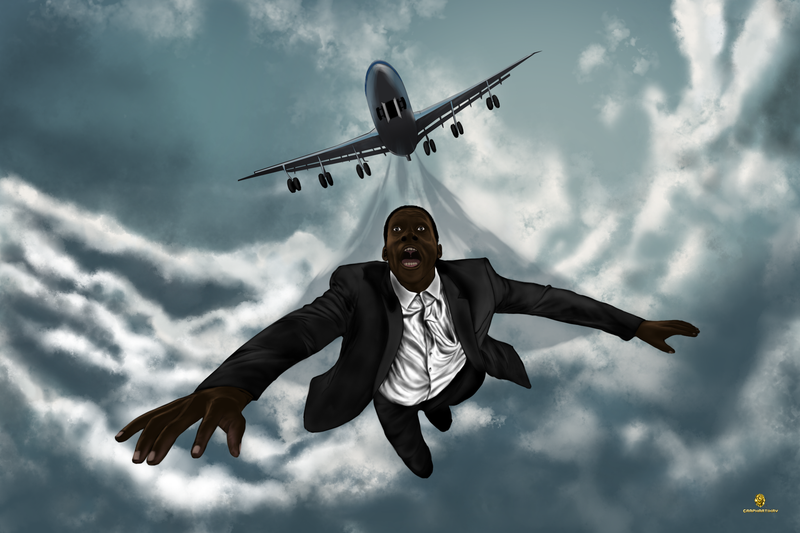
The project starts when a detained black man is thrown from a plan.
He is fearful and shocked; he thinks he is going to die as he is freefalling. He lands on a new planet, but he is in a deep coma for several days.
After days of almost loosing his life, he wakes up in a new world, hungry for a new beginning after a near death experience.
"Revelations" is a thought-provoking illustration that serves as a powerful commentary on how the journey of the most horrendous experience in one's life might feel.
This piece introduces the protagonist's journey, by encapsulating the initial shock of dislocation and the fragmentation of self-identity.

It represents the fear and confusion of being stripped of control and thrust into the unknown. It symbolizes the fear and confusion that accompanies being thrust into an unknown environment.
This artwork is designed to confront viewers with a visceral and emotionally charged experience, inviting them to confront uncomfortable realities.
🛒 Shop Revelations — Canvas & Fine Art Prints
2° The planet of truths:
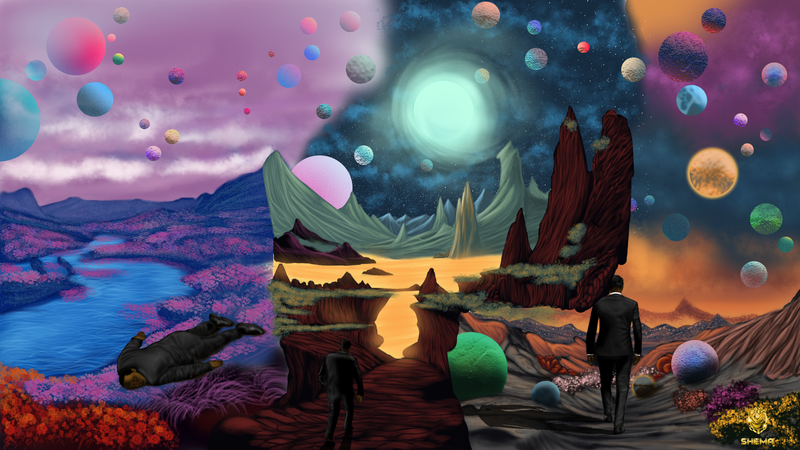
Upon landing, the protagonist helplessly dwells in coma for many days but fortunately doesn't die.
He suddenly wakes up in a new unknown territory. As he walks hoping to find provisions, he stumbles upon fascinating treasures: "an ethereal planet, towering murals and alien landscapes rendered in greens and blues",
He is in The Planet of Truths, unbeknownst to him. But he is far from being surprised just yet. After hours of walking, he encounters monumental caves and enters hoping to find something.
Planet of truths is a multi-artwork digital project which depicts the protagonist from the moment he wakes up, up to when he finds the artifacts.

The artwork highlights the beauty of the new planet but also the deliberate manipulation of history and identity, with intricate textures, colorful landscapes conveying both the weight and fragility of these long-buried truths.
🛒 Shop Planet of Truths — Giclée Fine Art Poster
3° Hidden Artifacts
In Hidden Artifacts, the protagonist enters a shadowed cave — a place of silence, secrecy, and memory long concealed. The cave becomes more than a physical setting; it is a metaphor for the archives of truth deliberately hidden from the world. Within its walls lies a collection of artifacts, manuscripts, and suppressed histories that piece together the "true" story of humanity.
Among these are echoes of civilizations erased or distorted: the grandeur of the Kemet empire, fragments of the books destroyed in the Library of Alexandria, and records of genocides denied recognition. Scattered throughout are rare inventions attributed to the wrong hands, confidential reports of political betrayal and corruption, surveillance of Black liberation movements. The cave also holds chilling mysteries of modernity : documents on infamous plane crashes, alongside whispers of otherworldly beings and forces beyond human comprehension.

Artistically, the artwork portrays the protagonist seated in this cavern, surrounded by relics of erased memory and silenced truth. His face is marked by shock as he reads a prohibited book recounting the hidden and glorious history of Black people, a history deliberately suppressed to perpetuate control and oppression. His shock embodies the breaking point: the moment when hidden history collides with lived identity.
🛒 Shop Hidden Artifacts — Premium Canvas Print
4° The Ritual of Race:
As he exists in the cave where he finds controversial artifacts, he stumbles and gets thrown into a huge hole.
Under that hole, in the underworld, he witnesses the colors curse where the devils paint the human neutral skin. That leads to humans realizing the difference within themself and therefore comes the discrimination, marginalization.
The artwork showcases abstract bodies, neither human nor alien, stand neutral until devils in vivid, chaotic colors—fiery reds, sickly yellows, and corrosive greens—hurl paint at them. The cursed colors symbolize the forced imposition of racial identity, transforming neutrality into division. The protagonist witnesses this with growing anguish, his mind splintering under the weight of imposed perception.
This painting critiques the artificial nature of racial constructs and their enduring psychological impact on marginalized individuals.

5° Internal Weapon
Following The Ritual of Race, Internal Weapon explores how systems of power maintain division after identity has been artificially constructed. If the previous chapter examined the creation of racial categories, this artwork investigates how those categories can be weaponized through surveillance, infiltration, and the manipulation of trust.
Inspired by historical infiltrations of liberation movements such as the Black Panther Party, the artwork is divided into three interconnected scenes. The first depicts community leaders meeting behind closed doors to discuss strategies for social advancement, unaware that trusted security guards are secretly recording their conversations. The second reveals law enforcement officers monitoring the meeting in a surveillance room filled with intelligence files, suspect profiles, incident reports, and evidence boards. The final scene illustrates how information gathered through surveillance can be reframed and transformed into misleading public narratives.
At its core, Internal Weapon examines the transformation of protection into surveillance and trust into a mechanism of control. Rather than relying solely on direct force, the artwork suggests that systems of power can operate through proximity, loyalty, and internal division, recruiting individuals from within targeted communities to advance their own objectives.
Through its symbolic composition, Internal Weapon raises questions about betrayal, complicity, and the hidden structures that shape public perception. It serves as a bridge between The Ritual of Race and The House of Headlines, showing how surveillance becomes the raw material from which narratives are manufactured and disseminated.
6° Corrupted Mind
"Corrupted Mind" explores how the human mind can be shaped, manipulated, and altered by invisible external influences. The artwork portrays the psychological state of an individual whose perception of the world has been progressively contaminated by distorted narratives, social pressures, and ideological systems of control.
"Corrupted Mind" questions the fragility of human consciousness when confronted with forces that seek to shape it. The piece invites the viewer to reflect on the origin of their own beliefs and on how systems of information, power, and culture silently influence our understanding of the world.
Within "Corrupted Mind," several symbolic elements deepen the representation of the character's psychological state.

The rotten fruits embody the gradual deterioration of the mind. Traditionally associated with fertility, growth, and abundance, the fruits appear here corrupted and altered. They symbolize thoughts, beliefs, and perceptions that, instead of nourishing the mind, have been contaminated by misinformation, trauma, and distorted narratives. Their state of decay reflects a mind invaded by toxic ideas, preventing the individual from accessing a healthy understanding of themselves and the world.
The tree, on the other hand, represents generation and the continuity of life. It symbolizes the transmission between generations and the origin of knowledge, values, and identity. In this work, it also evokes a more universal figure: that of the primordial feminine, often associated with the mother, with Mother Nature, or with the cradle of humanity. The tree thus becomes a metaphor for the source of life and human consciousness.
However, when the fruits of this tree are corrupted, it suggests that something has been altered within the transmission itself. Generations then inherit wounds, falsified narratives, and conditioning that perpetuate as a cycle.
Thus, the tree represents the origin and continuity of humanity, while the rotten fruits illustrate the degradation of the human mind when exposed to destructive influences. Together, these symbols question how systems of power, historical narratives, and social environments can deeply affect the way individuals think, perceive, and construct themselves internally.
Through a symbolic representation of the brain and the mind, the artwork shows how misinformation, cultural conditioning, and structures of power can infiltrate human thought to the point of altering the ability to distinguish truth from fiction.
In this vision, the mind becomes a battlefield. Ideas, beliefs, and perceptions do not always emerge freely; they can be implanted, maintained, or manipulated to sustain certain social and political hierarchies.
7° Retail Therapy
"Retail Therapy" is the seventh chapter of "The War Within: Breaking Out of Perdition." The artwork explores the psychological aftermath of marginalization and the ways in which consumer culture becomes a coping mechanism for unresolved internal conflict.

The piece portrays a couple walking through a modern urban environment, surrounded by the visual language of luxury — shopping bags, neon lights, and symbols of status. Their bodies, however, are rendered as transparent, revealing their internal systems: the heart, lungs, nervous system, and brain. What appears whole and composed on the outside contrasts with what is taking place within.
Inside the body, the organs are not neutral. They are marked, strained, and altered. The heart carries the weight of status and validation. The lungs reflect exhaustion and the environments that shape survival. The nervous system appears overstimulated, saturated by constant external stimuli. The brain reveals the psychological toll — anxiety, pressure, and the search for relief.
In this work, luxury is no longer external. It infiltrates the body. Symbols of success begin to circulate through the same internal spaces where healing should occur. The boundary between identity and performance becomes blurred.
"Retail Therapy" critiques the illusion of inclusion — the belief that access to wealth, consumption, and status equates to acceptance within systems that remain structurally unequal. It highlights how consumerism can offer temporary relief while leaving deeper wounds unresolved.
Rather than presenting consumption as the problem, the artwork interrogates what drives it: the internalization of pressure, the need for recognition, and the search for dignity in a system that often withholds it.
Within the broader narrative of "The War Within," this chapter represents a crucial stage: the moment where external systems of control begin to manifest as internal habits and coping mechanisms. The struggle is no longer only imposed — it is lived, embodied, and repeated.
"Retail Therapy" ultimately reveals a paradox: what appears as empowerment on the surface may, beneath it, reflect an ongoing internal battle.
Own a piece of The War Within
Three chapters of this series are now available as museum-quality prints.
Revelations Canvas Hidden Artifacts Canvas Planet of Truths Poster


1 comment
This is wild yet it is the best way to describe the origin of the battles fought from within
Leave a comment